
Files you download from the Internet are often compressed or zipped so that they take up less space and arrive much faster than files that haven’t been compressed. You can easily identify compressed files by their extensions, such as .zip (a common standard used in OS X and Windows) and .sit. Before you can use these files, you must learn how to unzip files on mac computers for proper access – luckily the process isn’t that complicated!
Dec 09, 2019 Using Extractor To Open RAR On Mac. There’s a free app on the App Store that lets you extract RAR as well as a few other archive formats on your machine. Launch the App Store, search for Extractor, and download it to your Mac. Open the app and you’ll see an interface asking you to add an archive. Feb 17, 2017 Click Extract. Using the File Explorer. To extract all or individual files from a zipped folder, do the following: Double-click the compressed (zipped) folder. Select the file or files you want to.
How to unzip files on mac computers
Unzipping a file on a mac computer is user-friendly and intuitive. To unzip files on a mac, simply follow the steps below:
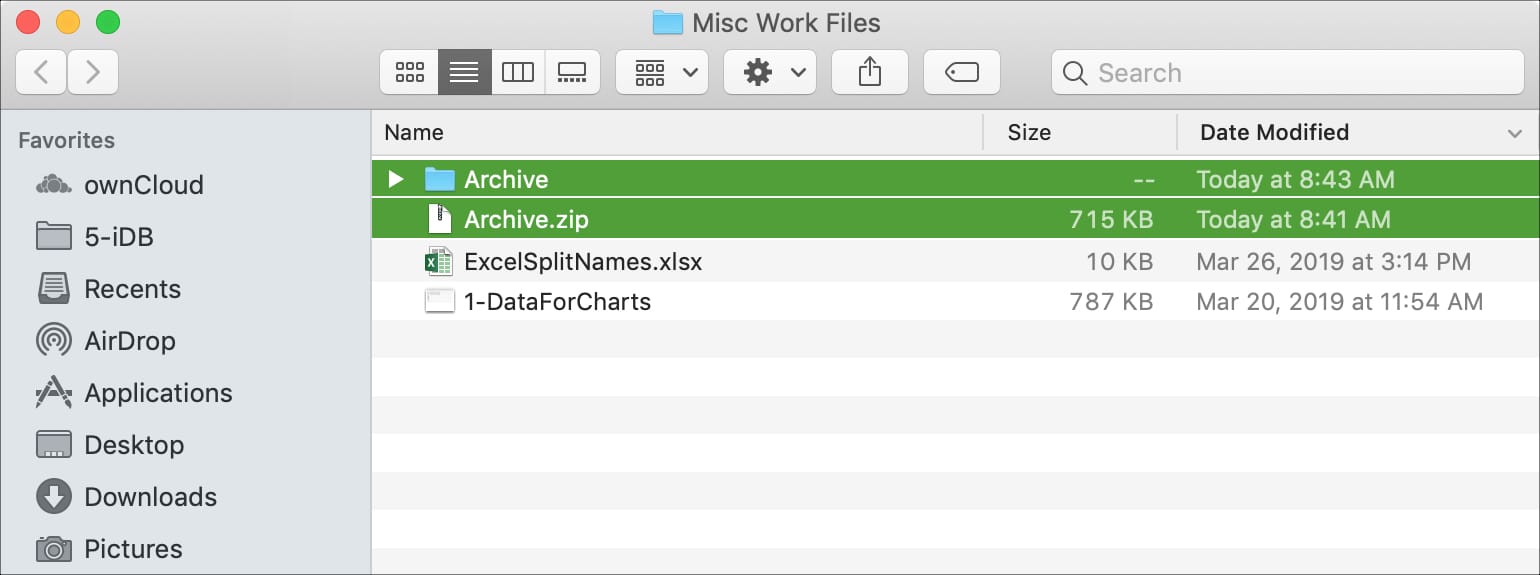
- Double click the zipped file.
- The file will automatically be decompressed by Archive Utility into the same folder the compressed file is in.
- Access the extracted files by clicking the appropriate icons.
Alternatively, if the method above does not work, you can right-click on the .zip package, and select Open With > Archive Utility (default).
Apple and third party software
Apple used to include a program called StuffIt Expander to decompress zipped files, but doesn’t now that OS X lets you unzip files (but not .sit files). However, StuffIt from SmithMicro Software still comes in handy for opening other types of compressed files, notably the .sit or .sitx compressed types. Go to www.stuffit-expander.com or www.stuffit.com/mac/index.html to download a free version of the software or to splurge for the Deluxe version. In addition to compressing files, StuffIt Deluxe lets you encrypt and back up files.
If your compressed file was downloaded from a website, it may be saved in the Downloads folder in your Documents or user directory. Launch WinZip from your start menu or Desktop shortcut. Open the compressed file by clicking File Open. If your system has the compressed file extension associated with WinZip program, just double-click on the file. Reinstalling The Unarchiver. Try to uninstall the app and then reinstalling from either the Unarchiver.
Meanwhile, you can archive or create your own .zip files through OS X, which is useful if you’re e-mailing a number of meaty files to a friend. Right-click (or Ctrl-click) files you want to compress inside Finder and choose Compress Filename. The newly compressed files carry the .zip extension. The archive is created in the same location as the original file and is named originalfilename.zip. You can also choose File→Compress. If you compress a lot of files at once, the archive takes the name Archive.zip.
By default, compressed files are opened with the Archive Utility. It appears in the Dock (in Leopard) while the files are being unsqueezed, unless you choose to open them with Stuffit Expander or some other program.
How to zip files on a mac
On the flip side, you can also archive or create your own .zip files through OS X, which is useful if you’re e-mailing a number of meaty files to a client or friend. Follow the step-by-step instructions below to easily zip files on a mac:
- Right-click or Ctrl-click the multiple files you want to compress (whether on the desktop or inside the Finder).
- Select Compress Filename from the pop-up menu.
- The files are now compressed in a .zip extension and the archive is created in the same location as the original file name, except with the .zip appended to its name.
On some Apple computers, you can also compress a file by simply choosing File→Compress. If you compress a lot of files at once, the archive takes the name Archive.zip.
Wondering how to open a RAR file on your Mac?
Well, you’re not alone. 🙂
Many of the files you tend to open these days come in either a ZIP (.zip) file or a RAR (.rar) file. But unlike ZIP files, Apple’s macOS (or OSX) which is the operating system on your Mac does not have the tools needed to open RAR files on its own.
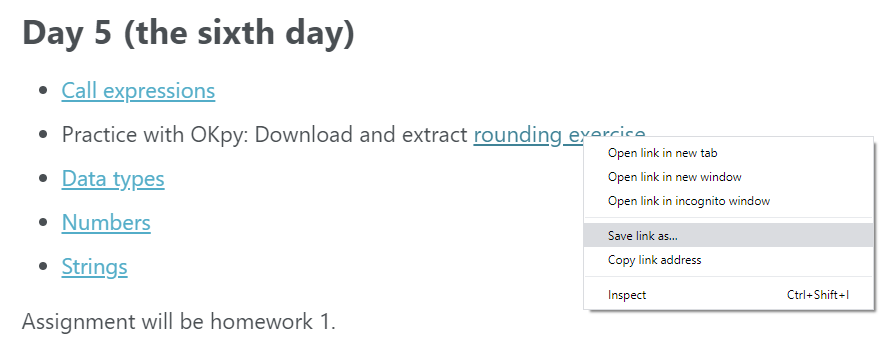
You will need a third-party app to open an RAR file and extract its contents. Now there’s tons of apps on your Mac’s App Store that you can download to open RAR files but what most Mac users have found and personally myself has been The Unarchiver app.
It’s a free, small in size, and simple app that helps you to unarchive (hence the name) many different kinds of files and not just RAR files. Think of it like a Swiss-army knife which comes in handy for opening many occasions (in this case opening different files you might find).
You can open ZIP, RAR (including v5), 7-Zip, Gzip, B-zip and even some of those older formats such as StuffIt and DiskDoubler. Not just that, it comes in handy too if you’re looking to open ISO or BIN disk images and a few Windows.EXE installers.
Extract File On Mac
In this guide, I’ll show you how you can use The Unarchiver app to open and extract RAR files on Mac OSX. 🙂
How to Extract RAR files on Max OSX: 3 Steps
Step 1: Go ahead jump into your Mac App Store and look for The Unarchiver (I have added the link for you here). You can also download it from the The Unarchiver site.
Recommended

The developer of Unarchiver does recommend that you download it from his site rather than the Mac App Store because of the limitations and sandboxing requirements that are set by Apple.
Which basically means if you want to make sure that you are getting the Unarchiver app with all its latest capabilities, then download it from the Unarchiver site.
If not you can still choose to download it from the Mac App Store. Either way will still allow you to extract RAR files on your Mac OSX.
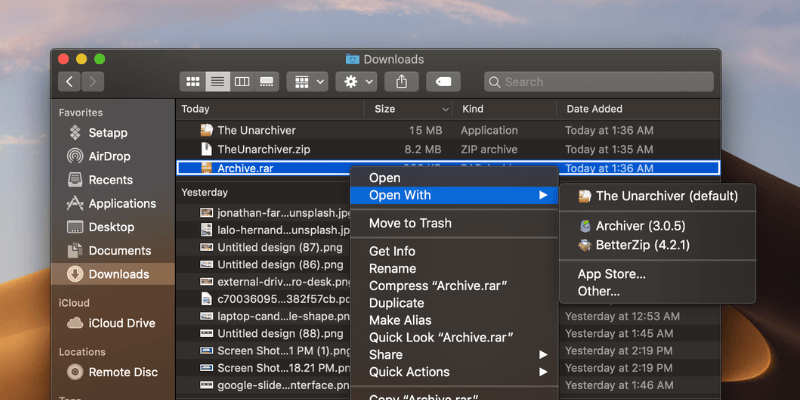
Step 2: Once you’ve installed The Unarchiver app, all that you have to do now to is just to drag and drop your RAR compressed file onto the Unarchiver’s icon.You can also right click on the RAR file on your Mac and then select Open With and then choose The Unarchiver.
Step 3: Finally, The Unarchiver will extract the compressed files into that same folder.
That’s it! You can use these files likehow you would with any of your other files. 🙂

Help! The Unarchiver is not working for me.
Have you updated your Mac’s operating system (OS) recently?
Then you’ll find that Unarchiver might not work as it usually does.
Here’s what you can do to fix it.
1.Reinstalling The Unarchiver.
Try to uninstall the app and then reinstalling from either the Unarchiver website or your Mac App Store. Sometimes the new Mac OS updates might tend to mess up the app, so the uninstall-reinstall should do the trick.
2.Firewall.
If you still find that Unarchiver doesn’t work for you, then it could most likely be that your Firewall may be getting in the way of the Unarchiver.
Just give the Unarchiver app arefresh by closing it and re-opening it to see if that has it fixed. If not, make sure that you have allowed Unarchiver to have access to receive incoming connections in your Security & Privacy in your Mac’s Settings.
Extract File Download For Mac Windows 10
Share this guide with anyone, your friends or even your family and help them if they’re looking to learn how to extract RAR files on Mac OSX. 🙂