
The function keys on your Mac’s keyboard are probably the least used of all. In fact, they’re so underused that by default when you press a function key it doesn’t act as a function key at all. Instead, it performs its other duty, whether that’s media playback control, brightness adjustment, or invoking Launchpad or Mission Control. To use a function key as a function key, you must hold down the fn button at the bottom left of your keyboard.
- Microsoft Word Shortcuts Cheat Sheet
- Thesaurus Shortcut In Word For Mac
- Keyboard Shortcuts In Word For Mac 2019
Move to the right edge of the current word (works for left-to-right and right-to-left text) Option-Right Arrow. Move the insertion point to the beginning of the current text area (document, text box, shape or table cell) Command-Up Arrow. Extensive list of Keyboard shortcuts as a word document. Extensive list of Keyboard shortcuts as an excel document A Macintosh Keyboard is available showing general Macintosh keyboard shortcuts Go to Entering and Editing Text in Microsoft Word Go back to Using Microsoft Word.
In the WordPress visual editor you can use a combination of keys to do things that normally need a mouse, trackpad or other input device. Rather than reaching for your mouse to click on the toolbar, you can use the following keyboard shortcuts: Windows and Linux use “Ctrl + letter”, Mac uses “Command (⌘) + letter”. Use your keyboard shortcut for the strikethrough effect (Mac only) Select the text you want to strike out in your Mac Word document; On your keyboard hold down Command + Shift + X; Note: Alternatively, if you don’t want to use your Word strikethrough shortcut you can just click the command for strikethrough in the Ribbon Guide using your.
Change the behavior of function keys on your Mac
Nevertheless, function keys can be very useful if you customize them to do what you want them to do. Here’s how to create some of the best time-saving function key shortcuts for your Mac.
Faster performance on Mac — take it
Download Setapp and discover endless shortcuts to automate your work. Everything you’re doing on Mac — finished 2x faster than before.
 That way you can reduce the size of the SSD you need. Maybe it's just like the issue on the MBP2010's where someone needed to swap the SATA cable from that model for the cable from the 2012 model like has posted in numerous other answers and comments:I have a feeling since my original MacMini HDD is negotiated at SATAI link speed, the cable can only handle that. I had change the optical drive with an SSD M4, on my Mac Mini 2010. Thus I reckon the Samsung 860 EVO tries to negotiate at SATAII which the chipset can handle, but the cable isn't up to it.This MIGHT mean I should use a replacement SATA Cable from the newer Mac mini models, instead of just replacing the original with like for like incase it's damaged (which it may or may not be) as they supported SATAIII (6Gbps):by. Leaving your HD as the data drive for your stuff.
Use function keys without pressing fn
First thing first, let’s make function keys functional again:
- To reverse the default behavior of function keys, go to the Apple Menu and select System Preferences
- Click on the Keyboard pane
- Choose the Keyboard tab
- Check the box next to “Use F1, F2, etc. keys as standard function keys”
Customize function key shortcuts with preset actions
The easiest shortcut you can make is re-assigning function keys themselves to more useful actions:
- In System Preferences, choose the Keyboard pane
- Click on the Shortcuts tab
- Choose one of the categories on the left-hand side
- Select a preset from the list
- If the preset already has a shortcut assigned, click on it and tap the function key you want to use
- If it doesn’t have a shortcut assigned already, click Add Shortcut and tap the function key
If the function key you’ve chosen is already assigned to something else, you’ll see a yellow warning triangle appear next to it and the original shortcut. You will have to alter one of them to proceed.
Create function key shortcuts with custom actions
Now, to actually create shortcut combinations, do the following:
- Launch the app for which you want to add a shortcut
- Go to the menu that hosts the command you want to create a shortcut for and make a note of the precise name of the command
- Go to the Keyboard pane in System Preferences
- Select the Shortcuts tab
- Choose App Shortcuts
- Click the plus button
- From the All Applications drop down menu, choose the app for which you want to add the shortcut
- In the Menu Title box, type the name of the command exactly as it appears in the application’s menu
- Type the function key shortcut in the Keyboard Shortcut box
Now, whenever you’re in that app and tap the assigned function key, it will perform the specified command. For example, if you set up a shortcut to save a document as a template in Pages and assign it to the F1 key, then when you’re using Pages and press F1, the current document will be saved as a template.
Secret Folder constitutes the perfect solution if you wish to prevent occasional users of your Mac to view, open, or change files or documents while browsing the contents of your hard drive. Home folder mac. The Library Folder on your Mac contains Preference Files, Caches, and Application Support Data. While regular Mac users may not find the need to access the Hidden Library Folder, advanced Mac users will at times come across the need to access files inside the Library Folder for. Move, rename, delete videos/photos from one folder to another - Multiple view options. If You Like The App Then Please Review It. Best Secret Folder offers premium subscription which is available on a yearly tier, auto-renewable. The yearly subscription is priced at 14.99 USD (or local equivalent) per year. Secret Folder constitutes the perfect solution if you wish to prevent occasional users of your Mac to view, open, or change files or documents while browsing the contents of your hard drive. Secret Folders is very useful to keep your information away from prying eyes or kids who may accidentally modify or delete your files. The 3.0 version of Secret Folders for Mac is provided as a free download on our website. Some of the software aliases include 'Passworded Folders'. This Mac app is a product of Stephen Colbran. This app's bundle is identified as net.samuco.Secret-Folders.
If you want to go further than customizing function keys, there are several apps that can help you work faster and become even more productive. Best free office suite for windows 10.
Quick Tips: make your own shortcuts to work faster and more efficiently
Expand text with Rocket Typist
Microsoft Word Shortcuts Cheat Sheet
If you find yourself typing the same phrases over and over again in email messages or documents, Rocket Typist is your holy grail. It allows you to store organized snippets of text and recall them with custom abbreviations.
For example, instead of typing “Hello, my name is John Appleseed, I am a developer interested in…” you could just type “hmn” and Rocket Typist will fill out the rest. You could also find the pre-saved phrase in the app itself and paste it in that way.
Rocket Typist shows how minimal but productive a text expansion app can be.
Rocket Typist supports macros for things like time and date so you can be sure the current time and date will be placed in your document. And you can share snippets using AirDrop or Mail.
Search intelligently with Lacona
Lacona is a bit like a keyboard version of Siri for those of us who don’t like talking to our Mac. Press the keyboard shortcut to invoke its text input bar and type a command, such as “search Amazon for bluetooth speakers” or “schedule lunch with Carol at 1pm tomorrow,” or even “play Born to Run.” As you type, Lacona will show a list of suggestions beneath the window, and you can use the arrow keys to navigate to and select the one you want.
Get a keyboard version of Siri
Automate your search on Mac with Lacona, an app that interprets what you’re typing and does what you’re asking for. Like Siri, only with text.
Lacona can also perform actions like copy, move, and rename on files in the Finder and activate system events like Empty Trash and Shutdown, it can create reminders and make calls, quit, activate and relaunch apps, and so much more, all by typing in its text bar. The app can even hook into third-party services, like IFTTT, so you can control those just by typing as well.
Create custom gestures with BetterTouchTool
Apple’s built-in gestures for the Trackpad and Magic Mouse are great, as far as they go. With BetterTouchTool (BTT) though you can take them much much further. The app allows you to create completely custom gestures and assign them to actions, which can be either global or application specific.
In addition, BetterTouchTool allows you to create custom keyboard sequences to trigger actions, and has its own built-in clipboard manager and screenshot tool. So you could, for example, set up a gesture to take a screenshot and then edit it right in BetterTouchTool instead of saving it to the Desktop.
Save multiple text snippets with Paste
Paste is a clipboard manager that allows you to store multiple items for pasting later. It then categorizes each copied item and places it in its own section of the clipboard, which you can easily change. Moreover, Paste syncs your clipboard in iCloud, meaning you can access its pinboard on multiple devices.
To paste an item you’ve copied into a document, just use Paste’s keyboard shortcut to view the pinboard, find the snippet of text, image, URL, or whatever else you’ve copied, copy it and then paste it into your file.
As you can see, your Mac’s keyboard can be customized in different ways. By creating shortcuts for function keys as well as combinations of other keys, you can start working much more quickly and save time. And using the apps listed above, all of which are available to download for free on Setapp, you can take your productivity to another level altogether.
Meantime, prepare for all the awesome things you can do with Setapp.
Read on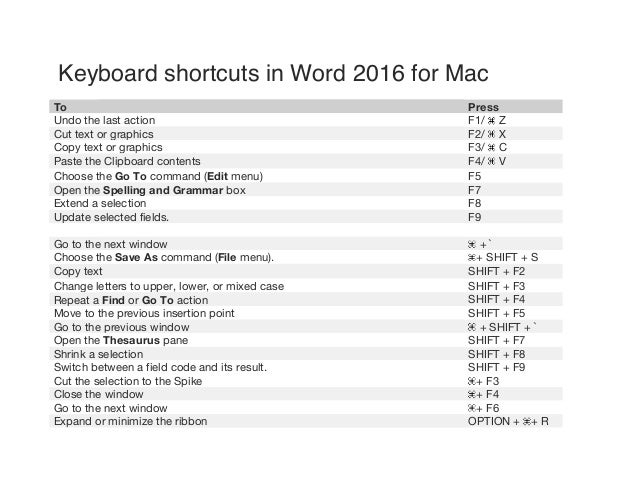
Sign Up
Below is a listing of the more commonly used shortcut keys in Microsoft Word. See the computer shortcuts page if you are looking for a list of shortcut keys used in other programs. Please be aware that some of these shortcuts may not work in all versions of Microsoft Word.
NoteIf the device you are using does not have function keys (F1-F12) on its keyboard, like a Chromebook, certain shortcuts will be unavailable to you.
NoteSome of the Microsoft Word shortcut keys below may not work in Word 365.
Thesaurus Shortcut In Word For Mac
| Shortcut | Description |
|---|---|
| Ctrl+0 | Toggles 6pts of spacing above the paragraph. |
| Ctrl+A | Select all contents of the page. |
| Ctrl+B | Bold highlighted selection. |
| Ctrl+C | Copy selected text. |
| Ctrl+D | Open the font preferences window. |
| Ctrl+E | Aligns the line or selected text to the center of the screen. |
| Ctrl+F | Open find box. |
| Ctrl+I | Italic highlighted selection. |
| Ctrl+J | Aligns the selected text or line to justify the screen. |
| Ctrl+K | Insert a hyperlink. |
| Ctrl+L | Aligns the line or selected text to the left of the screen. |
| Ctrl+M | Indent the paragraph. |
| Ctrl+N | Opens new, blank document window. |
| Ctrl+O | Opens the dialog box or page for selecting a file to open. |
| Ctrl+P | Open the print window. |
| Ctrl+R | Aligns the line or selected text to the right of the screen. |
| Ctrl+S | Save the open document. Like Shift+F12. |
| Alt+F, A | Save the document under a different file name. |
| Alt+X | Show the Unicode code of a highlighted character. |
| Ctrl+T | Create a hanging indent. |
| Ctrl+U | Underline the selected text. |
| Ctrl+V | Paste. |
| Ctrl+W | Close the currently open document. |
| Ctrl+X | Cut selected text. |
| Ctrl+Y | Redo the last action performed. |
| Ctrl+Z | Undo last action. |
| Ctrl+Shift+L | Quickly create a bullet point. |
| Ctrl+Shift+F | Change the font. |
| Ctrl+Shift+> | Increase selected font +1pts up to 12pt and then increase font +2pts. |
| Ctrl+] | Increase selected font +1pts. |
| Ctrl+Shift+< | Decrease selected font -1pts if 12pt or lower; if above 12, decreases font by +2pt. |
| Ctrl+[ | Decrease selected font -1pts. |
| Ctrl+/+c | Insert a cent sign (¢). |
| Ctrl+'+<char> | Insert a character with an accent (acute) mark, where <char> is the character you want. For example, if you wanted an accented é you would use Ctrl+'+e as your shortcut key. To reverse the accent mark, use the opposite accent mark, often found on the tilde key. |
| Ctrl+Shift+* | View or hide non printing characters. |
| Ctrl+<left arrow> | Moves one word to the left. |
| Ctrl+<right arrow> | Moves one word to the right. |
| Ctrl+<up arrow> | Moves to the beginning of the line or paragraph. |
| Ctrl+<down arrow> | Moves to the end of the paragraph. |
| Ctrl+Del | Deletes word to right of cursor. |
| Ctrl+Backspace | Deletes word to left of cursor. |
| Ctrl+End | Moves the cursor to the end of the document. |
| Ctrl+Home | Moves the cursor to the beginning of the document. |
| Ctrl+Spacebar | Reset highlighted text to the default font. |
| Ctrl+1 | Single-space lines. |
| Ctrl+2 | Double-space lines. |
| Ctrl+5 | 1.5-line spacing. |
| Ctrl+Alt+1 | Changes text to heading 1. |
| Ctrl+Alt+2 | Changes text to heading 2. |
| Ctrl+Alt+3 | Changes text to heading 3. |
| Alt+Ctrl+F2 | Open new document. |
| Ctrl+F1 | Open the Task Pane. |
| Ctrl+F2 | Display the print preview. |
| Ctrl+Shift+> | Increases the selected text size by one font size. |
| Ctrl+Shift+< | Decreases the selected text size by one font size. |
| Ctrl+Shift+F6 | Switches to another open Microsoft Word document. |
| Ctrl+Shift+F12 | Prints the document. |
| F1 | Open help. |
| F4 | Repeat the last action performed (Word 2000+). |
| F5 | Open the Find, Replace, and Go To window in Microsoft Word. |
| F7 | Spellcheck and grammar check selected text or document. |
| F12 | Save As. |
| Shift+F3 | Change the text in Microsoft Word from uppercase to lowercase or a capital letter at the beginning of every word. |
| Shift+F7 | Runs a Thesaurus check on the selected word. |
| Shift+F12 | Save the open document. Like Ctrl+S. |
| Shift+Enter | Create a soft break instead of a new paragraph. |
| Shift+Insert | Paste. |
| Shift+Alt+D | Insert the current date. |
| Shift+Alt+T | Insert the current time. |
You can also utilize the mouse to perform some common actions. The following section contains examples of mouse shortcuts.
| Mouse shortcuts | Description |
|---|---|
| Click, hold, and drag | Selects text from where you click and hold to the point you drag and let go. |
| Double-click | If double-clicking a word, selects the complete word. |
| Double-click | Double-clicking on the left, center, or right of a blank line makes the alignment of the text left, center, or right aligned. |
| Double-click | Double-clicking anywhere after text on a line sets a tab stop. |
| Triple-click | Selects the line or paragraph of the text where the mouse is triple-clicked. |
| Ctrl+Mouse wheel | Zooms in and out of document. |
Keyboard Shortcuts In Word For Mac 2019
Additional information